Family Feud Fast Money Rules: The 200-Point Goal, Two Clocks and What It Pays
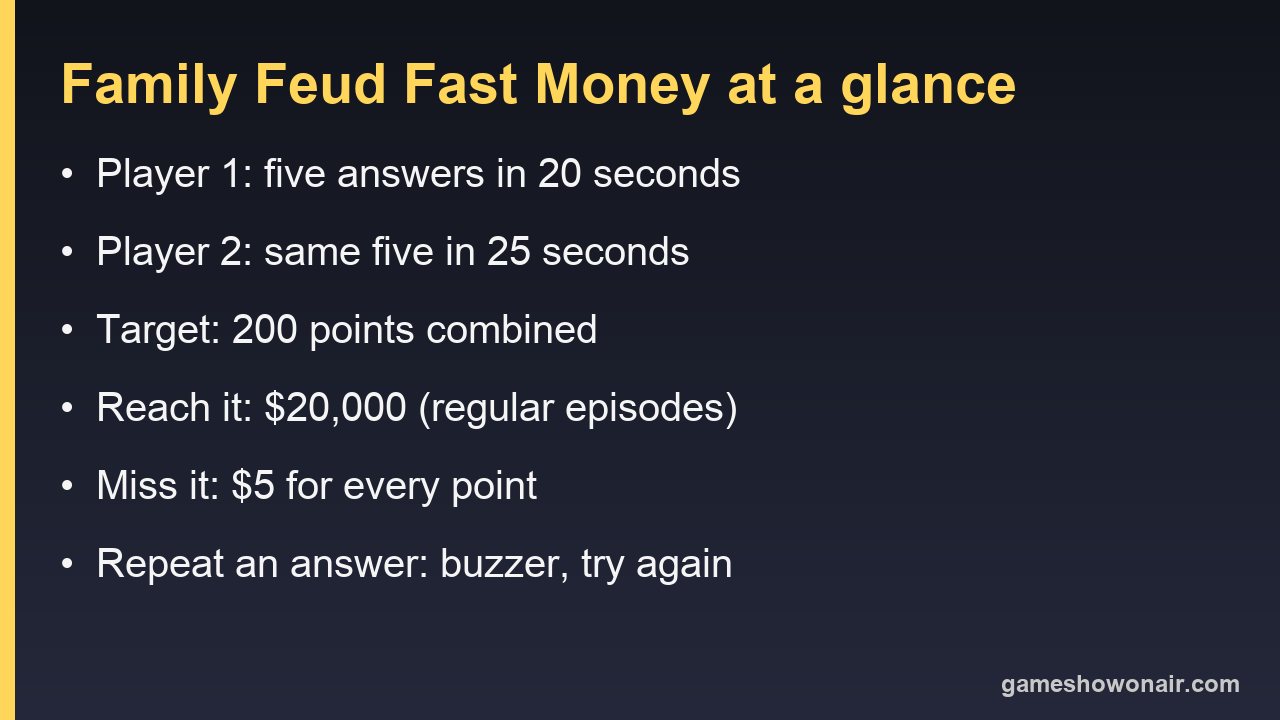
The gist: Two family members answer the same five survey questions, the first with 20 seconds on the clock and the second with 25. If their points add up to 200 or more, the family takes home $20,000 on a regular episode. Fall short and it's $5 per point.
That's the whole bonus round, and it lasts well under a minute. Most of the drama comes from one rule the second player hears about only when it bites: say something your partner already said and you get a buzzer, not points.
Below is how each piece works, what it pays now and what changes this fall. For when the new episodes air near you, our Family Feud time and channel guide has the station finder route; this page sticks to the rules.
Who plays Fast Money, and how does it start?
Only the family that wins the main game gets there. The main game is played to 300 points, and the winners pick two of their five members for the bonus.
One of the two leaves the stage. Wikipedia's description of the format says that player waits backstage wearing headphones, so they can't see or hear anything from the first half.
The player left on stage faces the host and the board. The clock starts once the first question is read.
How long does each player get?
Player 1 gets 20 seconds. Player 2 gets 25. Both have to answer the same five questions, so the second player's extra five seconds are there for a reason.
It wasn't always this generous. Until 1994 the limits were 15 and 20 seconds, and the extra five seconds apiece have stuck ever since.
| Player 1 | Player 2 | |
|---|---|---|
| Time on the clock | 20 seconds | 25 seconds |
| Before 1994 | 15 seconds | 20 seconds |
| Questions | 5 | The same 5 |
| Seconds per question | 4.0 | 5.0 |
| Can pass and come back? | Yes, if time is left | Yes, if time is left |
| Hears the other player? | No | No, waits offstage |
The per-question row is our math, not an official figure. Four seconds to hear a question and blurt a guess is tight, which is why so many players pass on a tough one and circle back.
What happens when the second player repeats an answer?
The double buzzer sounds and the host says "Try again." Player 2 then has to come up with something different for that same question.
Nothing else is lost, but every second spent on a repeat comes out of a 25-second clock. Player 2 is the only one who can hit this buzzer, since player 1 goes first and has nothing to repeat.
👉 The families that do well tend to treat player 1's answers as off limits in advance: if the obvious answer is taken, the second-most-obvious one is the play.
How does the 200-point target add up?
Each answer scores the number of people from a 100-person survey who gave it. The two players' ten answers are added together.
Here's what 200 means in practice, by our count:
- 10 answers, 200 points: an average of 20 points per answer.
- 45 seconds total: about 4.4 points needed for every second on the two clocks.
- One big first half: if player 1 posts 150, player 2 needs only 50 across five questions, or 10 per answer.
That last line is why a strong player 1 changes the whole mood of the round. A weak one leaves player 2 chasing 30-plus points per answer with a buzzer waiting on the top guesses.
How much does Fast Money pay?
On a regular episode, $20,000 for reaching 200. Miss it and the family gets $5 a point, so a 180-point round is worth $900.
Look at what that does to the last point. A family stuck at 199 leaves with $995; one more point is worth $19,005. On the 10 special episodes, where the jackpot can reach $50,000, that same point is worth as much as $49,005.
| Era | Fast Money top prize |
|---|---|
| Original ABC daytime run (1976 on) | $5,000 |
| Syndicated revival (1999) | $10,000 |
| From 2001, and through the Steve Harvey years | $20,000 |
| Season 28, 10 special episodes | Up to $50,000 |
The prize doubled in 2001. Wikipedia credits that change to a request from then-host Louie Anderson, and it has stayed at $20,000 since, apart from the 2009–10 season, when a returning Bullseye round let it float between $15,000 and $30,000.
What's different about Fast Money this season?
The 50th-anniversary season started Monday, Sept. 28, and BetMGM is raising the Fast Money jackpot to as much as $50,000 on 10 special episodes. Reports on the season, including AOL's and TV & Music Network's, both give those figures.
That's up to 2.5 times the usual prize for the same 200 points; Wikipedia's account has the family picking one of five envelopes worth $20,000 to $50,000. The rest of the round, clocks and target included, isn't reported to change, and we'll add which episodes carry the bigger jackpot once they're named.
What do five-time champions win?
A family can keep playing until it has won five games, then it retires. The bonus for that fifth win has changed a few times.
A new car was added in 2009, and Wikipedia says it was swapped for a $30,000 cash bonus in May 2024, then for a vacation and a $10,000 cash bonus that September. A Local 3 News report from February 2025 on a five-time winning family lists the same package: a trip to Barbados plus the $10,000 bonus.
Everything the family won along the way comes on top of that. The family in that report finished with nearly $92,000 combined.
How is Celebrity Family Feud's Fast Money different?
The money goes to charity, not the players. On ABC's version, the team that wins the main game plays for at least $10,000 for its chosen cause, and reaching 200 in Fast Money raises that to $25,000.
The team that loses the main game still sends $5,000 to its charity. Wikipedia describes the rest of the ABC format as matching the weekday show.
What about Fast Money records?
We looked, and the published claims don't agree. Different outlets name different players and scores for the best solo round of the Harvey years, so we aren't naming one here until two independent sources line up.
If you want to see the target hit on the nose, the official Family Feud channel posts Fast Money rounds almost daily, including the clip above.
FAQ
Can player 1 pass on a question? Yes. Either player can pass and return to it if there's time left on the clock.
Were the clocks always 20 and 25 seconds? No. They were 15 and 20 seconds until 1994.
Is Fast Money $50,000 on every episode now? No, just 10 special episodes this season. The rest pay the usual $20,000.
What if nobody reaches 300 in the main game? After four rounds, one sudden-death question decides it, and only the top answer counts.
The weekday Feud shares a lot of its audience with the two Sony shows. Our weeknight air-times guide covers all three, Wheel's Bonus Round and SPIN ID get the same rules treatment, and the longest Jeopardy! streaks show how different a no-cap champion system looks.
Each evening, Jeopardy! tonight and Wheel of Fortune tonight track who's playing, and past results sit in the archive. Harvey's show has its own Family Feud page, and if you'd rather play than watch, getting into The Price Is Right audience costs nothing.
Sources · Wikipedia — Family Feud (Fast Money timing, $5 per point, prize history, five-win bonus) · Market Realist — $20,000 Fast Money, 200 points, 20 and 25 seconds · AOL — 50th anniversary season, $50,000 Fast Money on 10 episodes · TV & Music Network — BetMGM $50,000 jackpot · Local 3 News — five-win prize: Barbados trip and $10,000 bonus · Wikipedia — Celebrity Family Feud charity amounts · Family Feud Wiki — Fast Money payouts and time limits
- How the Jeopardy! Buzzer Works: The Quarter-Second Lockout and the Hidden Lights
- Jeopardy! Daily Double Rules: The $5 Minimum, Where They Hide and the $25,000 Record
- Wheel of Fortune Bonus Round Rules: Why R, S, T, L, N and E Are Free
- Final Jeopardy! Wagering Strategy: The $1 Cover Bet and What 2nd and 3rd Place Should Risk