Final Jeopardy! Wagering Strategy: The $1 Cover Bet and What 2nd and 3rd Place Should Risk

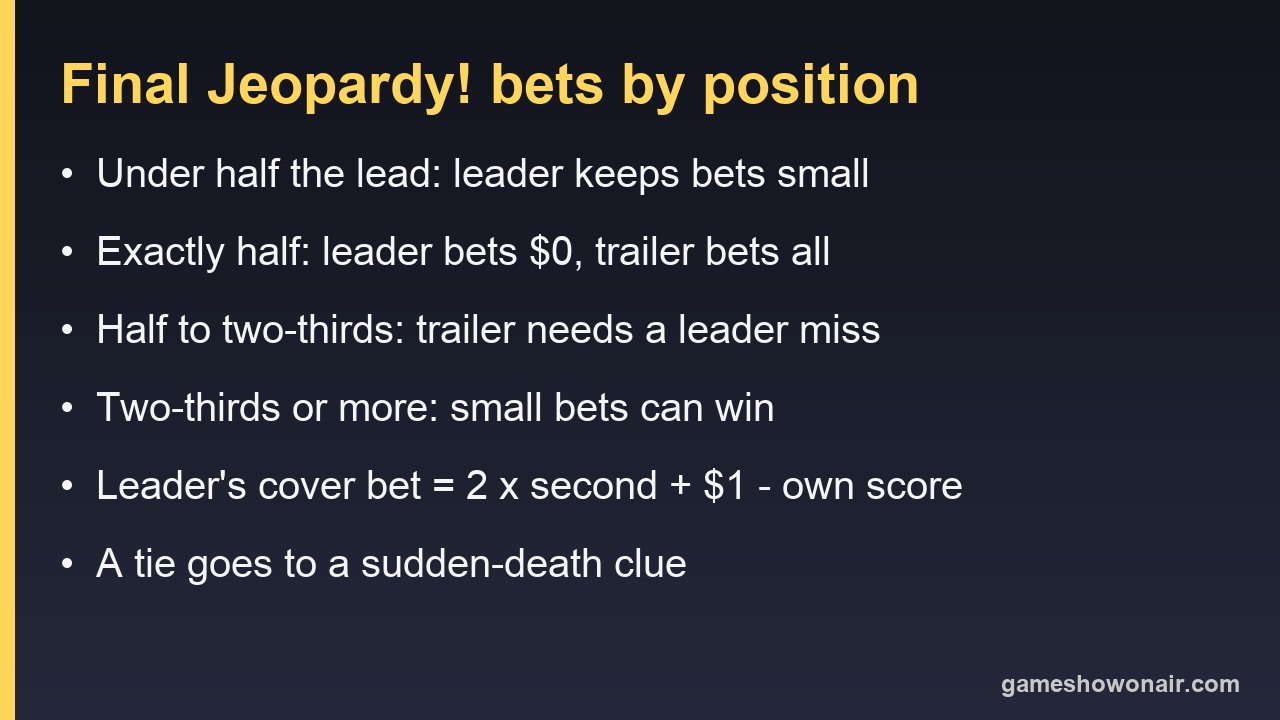
Bottom line: the leader should bet enough to finish $1 ahead of second place's doubled score, and everyone behind should plan for the leader getting it wrong. Nearly every sensible Final Jeopardy! wager falls out of that one idea, and you can check it from the couch with a single multiplication.
| Second place has… | Leader bets | Second bets |
|---|---|---|
| Under half the lead | Small: the game is locked | Whatever protects second |
| Exactly half | $0 (or $1, see below) | Everything |
| Half to two-thirds | The cover bet | Big: must be right |
| Two-thirds or more | The cover bet | Small can win |
Scenario boundaries follow the J! Archive glossary and The Jeopardy! Fan's wagering primer; the wording is ours.
What are the betting rules in Final Jeopardy!?
You can risk anything from $0 up to your whole score. The show's own rules rundown puts the Final Jeopardy! minimum at $0, against $5 for a Daily Double.
Wagers are locked in after the category is revealed and before the clue is. A player who ends Double Jeopardy! at zero or in the red doesn't take part.
Only the winner keeps the money on the lectern. Since Season 40 in 2023, second place gets a flat $3,000 and third gets $2,000, a change the producers announced on the show's podcast.
That last rule matters more than it looks. A trailing player isn't protecting a dollar total, only a finishing position, so going all-in costs nothing if second place is safe either way.
How much should the leader bet?
Double second place's score, add $1, subtract your own. That's the cover bet, and it wins the game on a correct response no matter what anyone else does.
The show's own site walks through a famous case: the 2019 game in which Emma Boettcher ended James Holzhauer's 32-game run. She led $26,600 to $23,400.
| Step | Math | Result |
|---|---|---|
| Double second place | $23,400 × 2 | $46,800 |
| Add $1 | $46,800 + $1 | $46,801 |
| Subtract leader's score | $46,801 − $26,600 | $20,201 |
She bet exactly $20,201 and finished on $46,801. The Jeopardy! Fan's primer adds a number from 2004 to 2011: leaders skipped the cover bet only 12.5% of the time.
👉 The logic behind it: losing because you missed the clue is forgivable. Losing after you got it right, because you bet too little, is the one that stings.
What if the leader has more than double second place?
Then it's a lock, or what Alex Trebek called a runaway. The leader can't be caught unless they overbet.
The largest safe wager is your score, minus twice second place's score, minus $1. Take a leader on $28,800 against $6,400: that's $28,800 − $12,800 − $1, so anything up to $15,999 is safe.
The J! Archive glossary calls the warning here Clavin's Rule, after the Cheers episode where Cliff bets a locked game and loses it all. The category will tempt you. The rule says don't.
What happens when second place has exactly half?
This is where the sources split, and the 2014 tiebreaker rule is why. J! Archive's definition says the leader bets $0 and can't finish worse than tied.
The Jeopardy! Fan's primer says it's now a choice. Bet $0 if you'd rather take your chances on a sudden-death clue, or $1 if you trust yourself in the category you've just seen.
Second place has no such debate. Bet everything and hope.
What should second place bet?
Start by assuming the leader makes the cover bet. If they're right, you've lost, so only the world where they miss is worth planning for.
Work out where a wrong answer leaves the leader. In the 2019 game that's $26,600 − $20,201, or $6,399.
Holzhauer sat far above that number, so he didn't need to gain anything. He bet $1,399, the most he could lose and still finish $1 ahead of third place's best case of $22,000.
Between half and two-thirds of the leader's score, that cushion is gone. A leader who misses still lands above you, so you need a correct response, and the primer puts the smallest useful bet at the gap plus $1.
From two-thirds up, the leader's missed cover bet drops them below your current score, so even a tiny bet wins whenever they miss. From three-quarters up, the primer says you can often do both: pass the leader's current score if right, and stay above their fallen total if wrong.
Can third place still win?
More often than the scoreboard suggests. The primer's line is that $0 is never a winning score, so don't bet it all without a reason.
Run the same sums for both players ahead of you. If each would fall below your current score on a wrong answer, a small bet wins when the board goes blank for everyone.
If they'd land between your score and double it, you need the right response and a real wager.
Why would a leader ever bet nothing?
Usually because of how second and third are stacked. J! Archive names the scenario after Faith Love, a 2002 champion who led $10,400 to $9,800 to $4,600.
The cover bet was $9,201. She bet $0 and won when all three missed.
The reasoning: second place had to guard against third, and that same guarded bet could only tie her if correct. Under the old rules a tie meant both came back as co-champions.
What happens if two players tie?
They play one more clue. The show's site describes it as sudden death: a new category, no dollar value, and the first correct response wins.
J! Archive dates the change to late 2014 and notes it wasn't announced at the time. The first regular-game tiebreaker didn't come until 2018, when Laura McLean beat Sarah Norris after both finished on $6,799, per J! Archive's record and WTKR's report of the game.
How can you check a wager from the couch?
Three steps, and they fit inside the think music.
- Double second place's score. If it's less than the leader's, the game is over barring a wild bet.
- If not, add $1 and subtract the leader's score. That's the bet you should see from the leader.
- Subtract that bet from the leader's score. Whoever stays above the result after their own wrong answer is still alive.
Try it against the scores on our Jeopardy! tonight page, which lists every wager from the latest game. Older nights are in the results archive.
Quick answers
Can you bet $0 in Final Jeopardy!? Yes. The minimum is $0 and the maximum is your full score.
Do losing players keep their scores? No. Second place receives $3,000 and third $2,000, whatever the lecterns say.
Who holds the records these bets are chasing? Our longest winning streaks list has the top ten, Holzhauer included.
How do you get to stand at that lectern? The audition guide covers the test and the call. For channels and start times, see the how-to-watch guide, and for repeats, the encore explainer.
Sources · Jeopardy.com — Final Jeopardy! Wagering Strategy · Jeopardy.com — 5 Jeopardy! Rules Every Contestant Should Know · Jeopardy.com — Jeopardy! First: A Tiebreaker · The Jeopardy! Fan — Wagering Strategy 101 · J! Archive — glossary of wagering terms · The Jeopardy! Fan — consolation prize increase · WTKR — first regular-game tiebreaker
- How the Jeopardy! Buzzer Works: The Quarter-Second Lockout and the Hidden Lights
- Jeopardy! Daily Double Rules: The $5 Minimum, Where They Hide and the $25,000 Record
- Wheel of Fortune Bonus Round Rules: Why R, S, T, L, N and E Are Free
- Family Feud Fast Money Rules: The 200-Point Goal, Two Clocks and What It Pays