How the Jeopardy! Buzzer Works: The Quarter-Second Lockout and the Hidden Lights
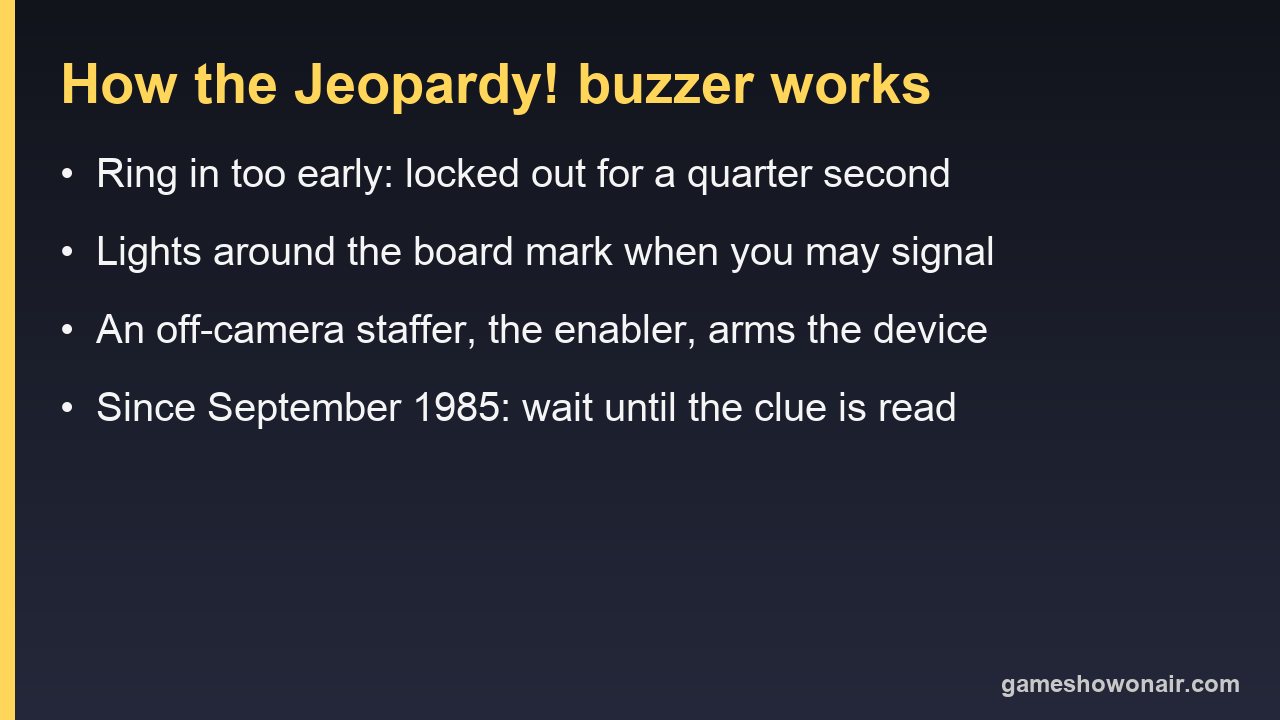
Ring in before the lights around the Jeopardy! board come on and the signaling device locks you out for a quarter of a second (0.25 seconds), while your opponents can still ring in. That is the whole penalty, and three people trying to be first make it matter.
Every clue ends the same way: the host stops reading, and the buzzers go live. What viewers never see is the staffer, the lights and the rule that make that moment fair.
What is the Jeopardy! buzzer, actually?
J! Archive's glossary calls it a signaling device, a buzzer that doesn't buzz: a hand-held cylinder with a push-button on top, something like an oversized click-pen, wired to a computer hidden inside the contestant's lectern.
It doesn't buzz either. Pressing it only tells the system you want to respond, and the system decides who was first.
When are you allowed to ring in?
Only after the host finishes reading the clue. J! Archive says an off-camera staffer, known as the enabler, triggers a set of lights around the board at that moment. Those lights are unseen by home viewers.
It wasn't always like this. According to Wikipedia's account of the format, contestants could ring in the instant a clue was revealed until the end of the 1984–85 syndicated season. Since September 1985 they have had to wait for the lights.
What happens if you ring in too early?
You are locked out for a quarter of a second. Both Wikipedia and Mental Floss, which quoted the show's own blog post on the subject, give that figure, and J! Archive describes it more loosely as a fraction of a second.
While you're locked out, the other two can still win the clue. If the first player to ring in misses, the remaining two get another chance to ring in, per Mental Floss.
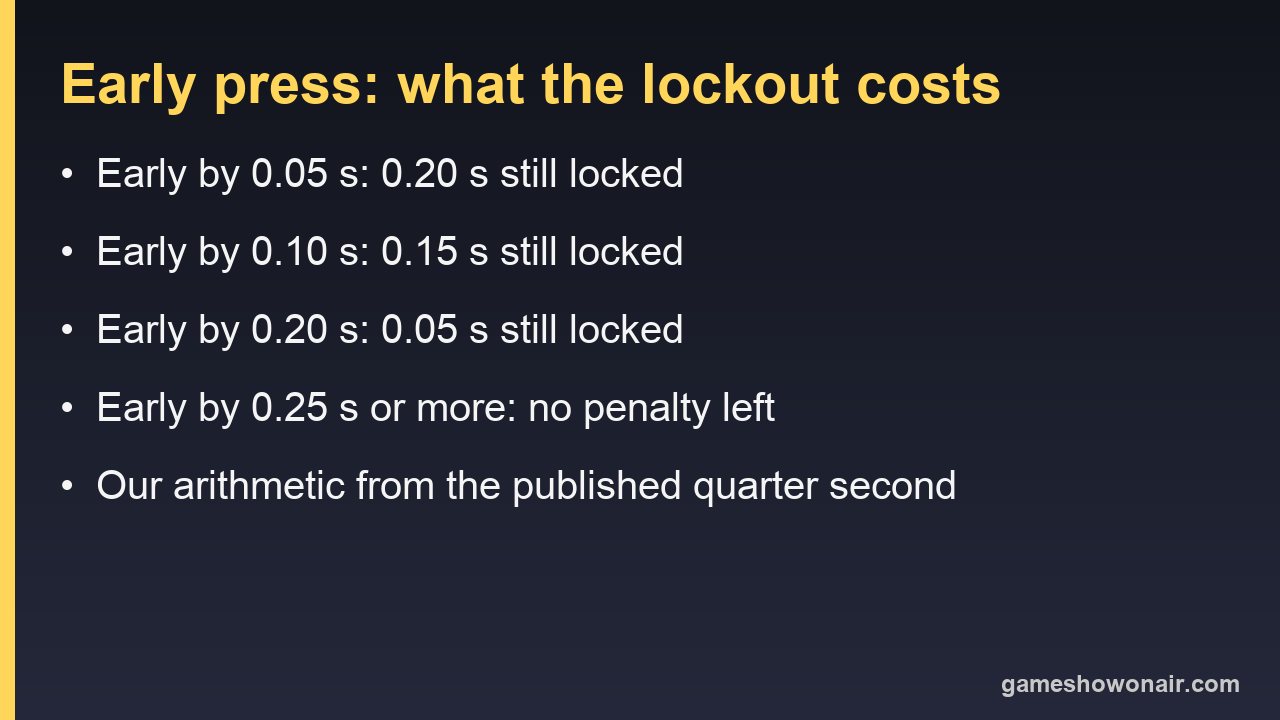
| You press early by | Lockout left when lights go on | Earliest press that counts |
|---|---|---|
| 0.05 s | 0.20 s | 0.20 s after lights |
| 0.10 s | 0.15 s | 0.15 s after lights |
| 0.20 s | 0.05 s | 0.05 s after lights |
| 0.25 s or more | None | Right at the lights |
Our arithmetic, assuming the quarter second runs from the moment of the early press. The show hasn't published a timing table.
Why does a quarter second matter so much?
Because jumping the lights costs more than it gains. A player who guesses the lights and goes 0.10 seconds early doesn't just lose that tenth; by the table above, they sit out another 0.15 seconds after the other two are live.
That is the whole design. In the 1985 change, the lights were added so that the home audience could play along more easily and an extremely fast contestant couldn't dominate, per Wikipedia. The lockout is what keeps the lights honest.
Should you just hold the button down?
No, and the show says as much. Its blog post, as Mental Floss quotes it, tells contestants to keep hitting the signaling device until they see the confirmation light on their podium or until the host calls on one of them.
The reason is that all three players can ring in before the system is armed. Pressing again is how a player makes sure a press lands once the system is armed.
Does the same device settle a tiebreaker?
Yes, with one twist. Per Wikipedia, tied players get a category and a single clue, and the first to buzz in must give the correct response; a player can't win by default if the opponent misses or forgets to phrase it as a question.
If neither gives the right response, another clue follows.
How much does being first on the buzzer actually matter?
A lot, but nobody is first on everything. The Jeopardy! Fan lists Greg Monson, who has won three straight games and $60,300 this season, as first on the buzzer on 69 of 171 tracked clues, or 40.35%.
Three players splitting a board evenly would each get about 33%, by our arithmetic, so Monson's 40% is a real edge. Controlling the board also decides who finds the Daily Doubles; our Daily Double wagering guide shows what a champion does with them.
Monson's night-by-night scores sit on the Jeopardy! tonight page, and every game is filed in the results archive.
Quick answers
Can you buzz in while the clue is being read? You can press, but it won't count; it locks you out for a quarter of a second.
Who turns the buzzers on? An off-camera staffer, called the enabler by J! Archive.
How long is the lockout? A quarter of a second, per Wikipedia and Mental Floss; J! Archive says a fraction of a second.
Can viewers see the lights? No. They sit on the board, unseen by home viewers, per Wikipedia.
How do I get on the show? The audition guide walks through it, and our Final Jeopardy! betting guide covers the other half of the game. For records, see the longest winning streaks.
Sources · J! Archive — glossary: signaling device · Wikipedia — Jeopardy! · Mental Floss — Why those Jeopardy! buzzers are anxiety-producing · The Jeopardy! Fan — Greg Monson career statistics
- Jeopardy! Daily Double Rules: The $5 Minimum, Where They Hide and the $25,000 Record
- Wheel of Fortune Bonus Round Rules: Why R, S, T, L, N and E Are Free
- Final Jeopardy! Wagering Strategy: The $1 Cover Bet and What 2nd and 3rd Place Should Risk
- Family Feud Fast Money Rules: The 200-Point Goal, Two Clocks and What It Pays