How to Get on Jeopardy!: The Anytime Test, the Video Audition and the 24-Month Pool

Key takeaways
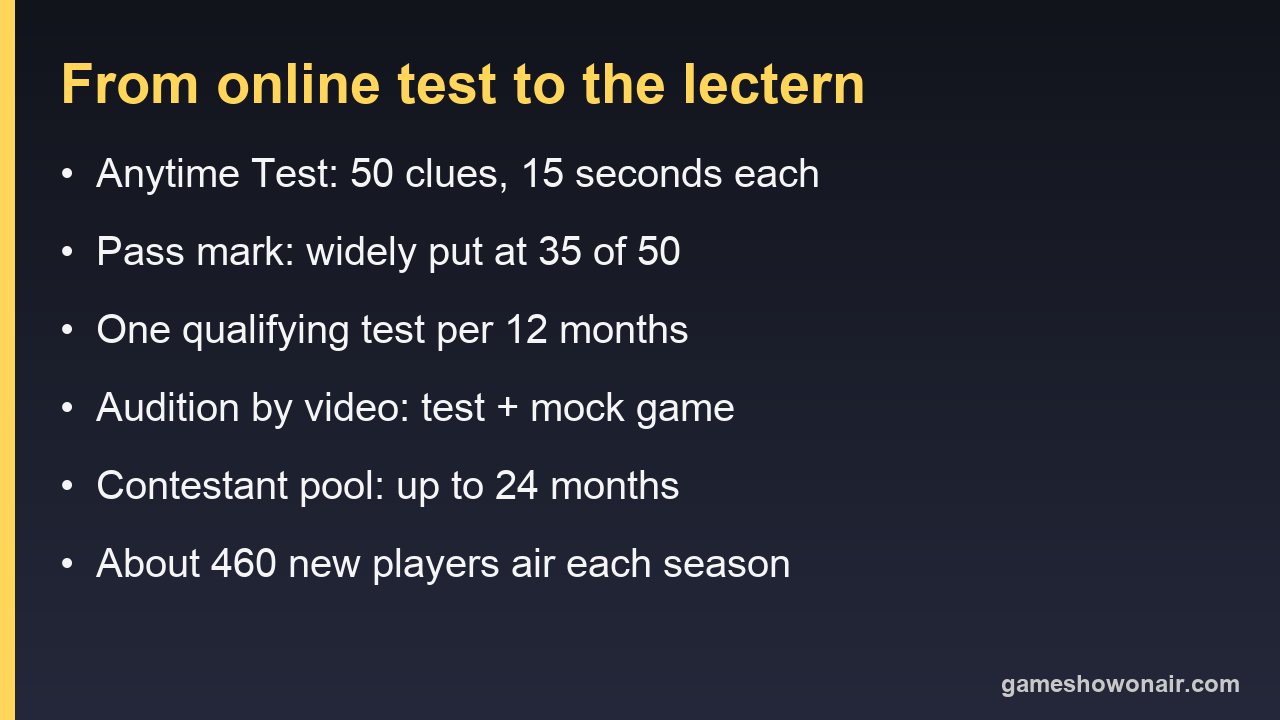
- There is one front door: the Anytime Test at jeopardy.com. Fifty clues, 15 seconds each, and you get one qualifying attempt per 12-month period.
- Passing does not buy you an audition. Passers go into a random draw, and the audition itself is now a video call with a second test and a mock game.
- Clear both and you sit in the contestant pool for up to 24 months — with no feedback, no score and no promise the phone rings.
The trivia is the part people prepare for. It is also the part that screens out the fewest people.
What is the Anytime Test?
It is a 50-clue online quiz you can take whenever you like, from the contestant section of the show's own site. Each clue gives you 15 seconds, and the whole thing runs about 13 minutes.
You need a MyJeopardy! account and completed contestant registration before you start, and you have to be 18 or older and a resident of the United States or Canada. The categories and clues come out of a database at random, so no two people get the same 50.
One rule catches first-timers: you type a plain answer. No responding in the form of a question here.
You can submit one qualifying Anytime Test every 12 months, plus one JeoparDAY! test in the same window. Miss the mark and the calendar, not the producers, is what makes you wait.
What score do you need?
The show has never published the cutoff, and it does not tell you your score either. The number that circulates in contestant circles — 35 or more out of 50 — comes from people comparing notes afterward, not from Sony.
A past champion put it plainly in his own write-up of the process: nobody knows the line, people guess 35 because that is what others who advanced remember getting.
What happens after you pass?
You wait, and then you probably keep waiting. Qualified test-takers go into a random selection process, and invitations can land any time within a year of the test.
That random draw is the real wall. Look at the numbers side by side and the shape of the thing changes.
| Stage | Roughly how many | Share of the previous stage |
|---|---|---|
| Take the online test | ~100,000 a year | — |
| Get an audition | 2,000–3,000 | about 2.5% |
| Appear on the show | 400–500 | about 18% |
👉 Once you are in the audition room, roughly one in five gets on television. Getting into that room is the one-in-forty step.
What does the audition look like now?
It runs in two parts over video conference, and takes about an hour. First another 50-question test in the same format as the one you already passed. Then gameplay: a mock game with a real signaling device rhythm, and a contestant interview where you talk about yourself.
You need reliable internet and a webcam — a phone or tablet front camera counts. That is the whole equipment list.
The second half is a casting session, not a quiz. Contestant coordinators are watching enunciation, energy and whether you can hold a conversation under lights. Champions who have written about it keep landing on the same advice: speak up, smile, and have two or three stories ready that are actually stories.

How long does the contestant pool last?
Up to 24 months from your audition date, per the show's current FAQ. You may see 18 months quoted in older guides and reference pages; that was the previous window, and it is the single most common out-of-date fact in Jeopardy! advice threads.
Nothing about the wait is transparent. No score, no ranking, no feedback, no explanation if the two years run out.
How much has the process changed?
| The old way | Now | |
|---|---|---|
| When you can test | An annual window of a few days | Year-round, any time |
| Where you audition | In person, regional cities | Video conference |
| What it costs you | Your own flight and hotel | An hour and a webcam |
| Pool length | 18 months | Up to 24 months |
The travel line is the one that changed who can realistically try. A regional audition used to mean a plane ticket to Los Angeles, Chicago or New York on your own dime, for a maybe.
What are the odds, honestly?
Here is our own arithmetic on it. Season 42 ran the customary 46 weeks, from Sept. 8 through the final first-run show on July 24, which is 230 half hours.
Two new challengers stand at the lecterns each night, since the champion comes back. That is about 460 seats a season before you subtract tournament weeks, where the same players return for days at a time. Against 100,000 test-takers, you are looking at roughly one seat for every 217 people who take the test.
Put another way: the show needs nine new faces a week, all season, and tens of thousands of people want them.
Does trivia ability decide it?
Up to a point. Breadth beats depth on the test — the clue set rewards someone who knows a little about opera, state capitals and 1990s sitcoms over a specialist.
After that it is buzzer timing and temperament. Watch any week of games and you will see two players who clearly knew the answer and one who got to ring in. Our week-by-week recaps are full of games decided on the last clue by someone who was simply faster on the signaling device, and the all-time streak list is mostly people who solved the buzzer, not people who knew more.
One of Season 43's early champions, Mark Ramirez, told his Instagram followers he had taken the test for years and auditioned four separate times before the call finally came. He is on the week-ahead page defending a two-game streak.
FAQ
Can you take the Jeopardy! test more than once a year? One qualifying Anytime Test per 12-month period, plus one JeoparDAY! test. Practice tests in the show's prep center do not count against that.
Do you get paid to be on Jeopardy!? You keep what you win. Non-winners receive consolation prizes, and travel to the studio has historically been the contestant's own expense — check your invitation letter, which spells out the current terms.
Is there a separate route for teens or college players? Yes, but not on the same clock. Teen and college tests run roughly once a season, when a tournament is actually being cast, and they are announced on the show and to the email list rather than sitting open year-round. The teen tournament has been on hold in recent years, so the college championship is the steadier youth door.
What about Wheel of Fortune? Different show, different system: there is no knowledge test at all. That process starts with the Wheel Watchers Club and a SPIN ID, which we walk through in our SPIN ID guide.
If you are in the pool now, the nightly games are your scouting tape. Tonight's card, the Final Jeopardy! category and the three scores land on our Jeopardy! tonight page, every game goes into the results archive, and if you simply need to find the show in your market, the air-times guide has the city list.
Sources · Jeopardy.com — Contestant FAQs (test format, audition, 24-month pool) · Jeopardy.com — Be on J! and the Test Prep Center · Wikipedia — Jeopardy! audition process · Jon Santiago — a past champion's account of the process · Matt Carberry — Season 42 schedule (46 weeks, Sept. 8–July 24) · Wikipedia — list of Jeopardy! tournaments and events
- Why Is Jeopardy! a Rerun? Weekend Encores, the 46-Week Season and Telling an Old Game From a New One
- Wheel of Fortune Next Week (Sept. 21–25, 2026): Words With Friends Week, $20,000 Giveaway
- Wheel of Fortune This Week (Sept. 14–18, 2026): All Five Bonus Puzzles, Every Winner and the $75,000 That Got Away
- Jeopardy! This Week (Sept. 14–18, 2026): Every Final Jeopardy!, All Five Winners and Who Returns Monday